

Training to Failure vs Close to Failure: What Works
Training to failure vs close to failure: stopping 0 to 3 reps short builds the same muscle with less fatigue. When failure is worth it, and how to gauge RIR.
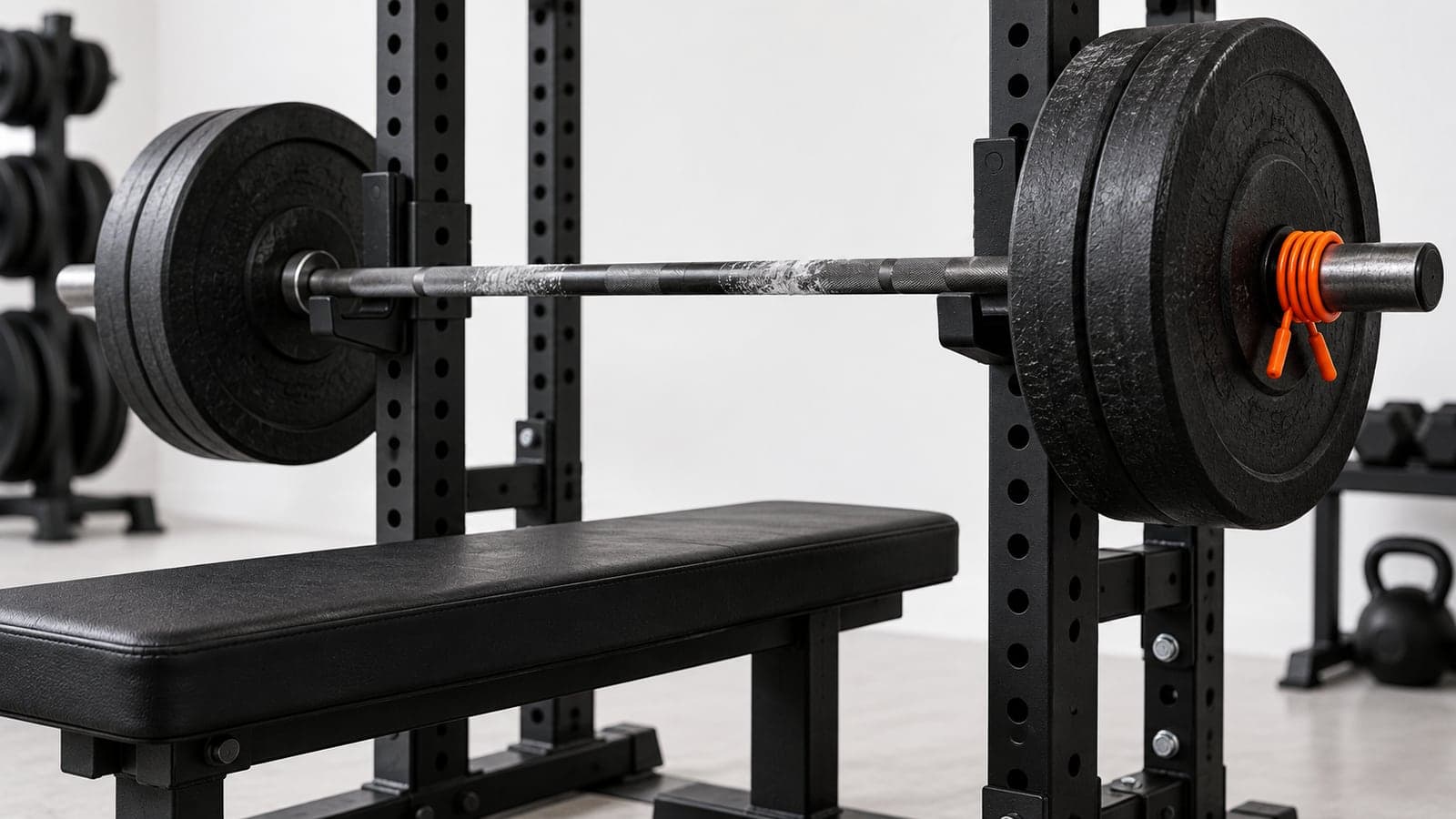
Training to failure vs close to failure: stopping 0 to 3 reps short of failure builds the same muscle as going all the way, with less fatigue and fewer lost reps on later sets. Failure has a place on the last set of isolation exercises. On squats, deadlifts and presses, stop 1 to 3 reps short.
RIR and RPE explained
Reps in reserve (RIR) is how many more reps you could have done with good form when you racked the weight. RPE is the same idea flipped: a 1 to 10 scale where 10 means nothing left. Zourdos and colleagues (2016) built the lifting-specific version of that scale and tied it to bar speed, so RPE 10 is 0 RIR, RPE 9 is 1 RIR, and so on.
| RPE | RIR | What it feels like |
|---|---|---|
| 10 | 0 | Could not do another rep. The last one moved slowly and maybe stalled. |
| 9.5 | 0 to 1 | Might have had one more, but probably not. |
| 9 | 1 | One more rep, and it would have been ugly. |
| 8 | 2 | Two more reps. Bar slowed on the last one. |
| 7 | 3 | Three more. The set was hard but controlled throughout. |
| 6 | 4 | Four more. Warm-up territory for a working set. |
| 5 or less | 5+ | Too easy to count as a working set. |
"Failure" in this article means momentary muscular failure: you tried a rep and it didn't go up. Not "it burned", not "I didn't fancy another one". Those are RIR 2 to 4 dressed up.
What the evidence says about training to failure
The research on this has moved fast since 2021, and it's more settled than the arguments online suggest.
Grgic, Schoenfeld, Orazem and Sabol (2022) pooled 15 studies and found no significant difference between failure and non-failure training for strength (effect size -0.09) or hypertrophy (effect size 0.22, with the confidence interval crossing zero). When volume wasn't equated, non-failure training was better for strength. In resistance-trained lifters specifically, there was a small edge for failure on hypertrophy (effect size 0.15). Their conclusion: failure isn't required, and it doesn't seem to hurt either.
Refalo, Helms, Trexler, Hamilton and Fyfe (2023) took a stricter approach and separated "momentary muscular failure" from looser definitions. Across 15 studies, failure by any definition had a trivial edge (effect size 0.19). Real momentary failure against non-failure had no advantage (effect size 0.12, not significant). They flagged a possible non-linear relationship: closer is better, up to a point, and then it isn't.
Refalo, Helms, Robinson, Hamilton and Fyfe (2024) then ran the experiment. Eighteen trained lifters did leg press and leg extension for 8 weeks, one leg to failure and the other leg at 2 RIR and 1 RIR respectively. Quad thickness went up 0.181 cm on the failure leg and 0.182 cm on the RIR leg. The failure leg lost far more reps from set to set and showed more fatigue every session, for the same growth.
Robinson and colleagues (2024) took the whole literature and ran meta-regressions on estimated RIR as a continuous variable. Strength gains were flat across a wide RIR range. Hypertrophy improved as sets got closer to failure. The authors were open that RIR in older studies had to be estimated and the fit was modest, but the direction is clear: for muscle, closer is better, and the last rep isn't magic.
Put together: 0 to 3 RIR is the zone. Inside it, the difference between 0 and 2 is small for growth and large for fatigue.
How to learn to gauge RIR
Nobody is born knowing what 2 RIR feels like. Steele and colleagues (2017) had 141 people predict their reps to failure on a full-body session and then go to failure. Most underpredicted by around 2 to 3 reps, and accuracy improved with training experience. Hackett and colleagues (2012) found bodybuilders estimating reps to failure at the end of sets of 10 were within about a rep by the third set. So the skill is learnable, and the way to learn it is test sets.
The test set method. Once every 2 to 3 weeks, on the last set of an exercise, call your RIR (out loud or in your head) at the point you'd normally stop. Then keep going to actual failure. Count the extra reps. That's your error. If you said 2 and got 5 more, you've been stopping at 5 RIR and your hard sets haven't been hard.
Do this on machines and isolation lifts, not on squats or bench without a spotter. Leg extension, leg press, cable row, pushdown, curl. After three or four test sets your calls tighten up. Then trust them, and retest now and then.
Bar speed. On compounds, the last rep before failure moves noticeably slower than the first. Once the bar slows visibly, you're at about 2 RIR. When the next rep slows again and you feel the sticking point, that's 1. Filming a set every few weeks makes this obvious.
When training to failure makes sense
- Last set of an isolation exercise. Leg extension, leg curl, cable fly, lateral raise, curl, pushdown. Low injury risk, nothing else in the session depends on it, and the small hypertrophy edge in trained lifters is worth having here.
- Machine compounds, now and then. Leg press, hack squat, chest press. A safety catch or a machine stop makes failure safe. Once a week on one of these is fine.
- Calibration. Test sets as above. This is failure as a measurement tool.
- The end of a block. The final week before a deload, push isolation work harder. You're about to rest anyway.
When it doesn't
- Barbell compounds. A failed squat, deadlift or bench rep is a safety problem and the fatigue cost is out of proportion. Stop at 1 to 3 RIR. Robinson's data says strength doesn't improve by going closer anyway.
- The first exercise of a session. Fail there and every set after it suffers. Refalo's 2024 lifters lost reps across sets on the failure leg, session after session.
- Beginners. Form breaks down before the muscle does, so "failure" is technique failure. Learn the lifts at 3 to 4 RIR for the first few months.
- Deload weeks. The whole point is to reduce fatigue. 4 to 5 RIR across the week. Deload week how often covers when to take one.
- Every set of every exercise. This is the common one. Ten sets to failure in a session isn't intensity, it's a recovery bill you can't pay. Volume drops the following session and the week nets out worse.
A sample week with RIR per set
Upper/lower, four days. RIR is listed per set in order.
| Day | Exercise | Sets x reps | RIR per set |
|---|---|---|---|
| Upper A | Bench press | 4 x 5-8 | 3, 2, 2, 1 |
| Barbell row | 4 x 6-8 | 3, 2, 2, 2 | |
| Overhead press | 3 x 6-8 | 2, 2, 1 | |
| Lat pulldown | 3 x 8-10 | 2, 1, 1 | |
| Curl, pushdown | 3 x 10-12 each | 2, 1, 0 | |
| Lower A | Squat | 4 x 5-8 | 3, 2, 2, 2 |
| Romanian deadlift | 3 x 6-8 | 3, 2, 2 | |
| Leg press | 3 x 8-10 | 2, 1, 0 | |
| Leg curl | 3 x 10-12 | 2, 1, 0 | |
| Upper B | Incline dumbbell press | 3 x 8-12 | 2, 1, 1 |
| Chest-supported row | 4 x 8-12 | 2, 2, 1, 1 | |
| Lateral raise | 4 x 12-15 | 2, 1, 0, 0 | |
| Cable fly | 3 x 12-15 | 1, 1, 0 | |
| Lower B | Deadlift | 3 x 4-6 | 3, 3, 2 |
| Split squat | 3 x 8-10 | 2, 2, 1 | |
| Leg extension | 3 x 12-15 | 1, 1, 0 | |
| Calf raise | 4 x 12-15 | 2, 1, 1, 0 |
The shape: compounds start at 3 RIR and finish at 1 or 2. Isolation work ends at 0. Nothing in the first slot of a session goes to failure. The rep targets follow the hypertrophy rep range rules: lower reps on the heavy lifts, higher on the cables. Full rest times and the program itself are in the 4 day upper/lower split, and rest between sets for hypertrophy covers why the rests are longer on the sets you take closer.
Mistakes
- Calling 4 RIR close to failure. Steele's data says most people are off by 2 to 3 reps in that direction. Do the test sets.
- Going to failure on set one. Then sets two, three and four each lose 2 to 3 reps. Your total reps for the exercise went down, not up.
- Grinding compounds to a stall every week. Two months later your shoulders hurt and the bench hasn't moved. Save 0 RIR for the cables.
- Confusing burn with failure. Sets of 15 to 20 burn long before they fail. If you stopped because it hurt, log it as 3 RIR, because that's what it was.
- Never going to failure. The other error. If you've never once failed a rep on a leg extension, you don't know where failure is, so you can't know how far from it you are.
How to track this in Ultra+
Judging RIR gets easier when you can see the last set you did. In Ultra+, every set shows your previous set for that exercise and your best set, on the input itself, so 80 kg x 8 last week gives you a straight comparison for today. If you got 8 again and it felt like 0 RIR instead of 2, something's off (sleep, food, the sets before it), and you know before you add weight.
Each exercise has a notes field that stays with it. Write the RIR of your last set there ("last set 1 RIR, bar slowed on rep 7") and it's waiting when you open that exercise next time. If you'd rather talk it through, ask Blaze. He reads your real sessions and can tell you when the last few weeks show falling reps at the same weight, which is what overreaching looks like in a log.
Start your free trial and your previous set is on the screen from the first workout.
Frequently asked questions
- Is it better to train to failure or stop a few reps short?
- Stop 0 to 3 reps short on most sets. Meta-analyses from 2022 and 2023 found no significant hypertrophy advantage for momentary failure over non-failure, and a 2024 trial found identical quad growth at failure and at 1 to 2 RIR with less fatigue in the RIR group. Take the last set of isolation exercises to failure if you like.
- What does 2 RIR mean?
- Two reps in reserve: you stopped the set when you could have done two more reps with good form. On the RPE scale that's an 8. The bar slows on the final rep but doesn't stall. Most lifters overestimate how close they are, so test it occasionally by continuing a set to actual failure.
- Does training to failure build more muscle?
- Slightly, in some analyses, and not at all in others. Robinson's 2024 meta-regressions found hypertrophy improved as sets got closer to failure, but the gap between 0 and 2 reps in reserve is small, while the extra fatigue is large. Failure is worth using on isolation work and not on heavy barbell lifts.
- Should beginners train to failure?
- No. In the first few months, form fails before the muscle does, so what looks like failure is a technique breakdown. Beginners grow fast at 3 to 4 reps in reserve and learn the lifts properly. Introduce failure on machines and isolation exercises after 6 months or so, one set at a time.
- How do I know if I'm training hard enough?
- Run a test set. On the last set of a machine exercise, note the rep where you'd normally stop, then keep going to failure and count the extra reps. If you got 4 or 5 more, your normal sets aren't hard enough. Repeat every few weeks until your estimate lands within one rep.
References
Every study below was opened and read before it was cited.
- Effects of resistance training performed to repetition failure or non-failure on muscular strength and hypertrophy: A systematic review and meta-analysisGrgic J, J Sport Health Sci, 2022
- Influence of Resistance Training Proximity-to-Failure on Skeletal Muscle Hypertrophy: A Systematic Review with Meta-analysisRefalo MC, Sports Med, 2023
- Similar muscle hypertrophy following eight weeks of resistance training to momentary muscular failure or with repetitions-in-reserve in resistance-trained individualsRefalo MC, J Sports Sci, 2024
- Exploring the Dose-Response Relationship Between Estimated Resistance Training Proximity to Failure, Strength Gain, and Muscle Hypertrophy: A Series of Meta-RegressionsRobinson ZP, Sports Med, 2024
- Novel Resistance Training-Specific Rating of Perceived Exertion Scale Measuring Repetitions in ReserveZourdos MC, J Strength Cond Res, 2016
- Ability to predict repetitions to momentary failure is not perfectly accurate, though improves with resistance training experienceSteele J, PeerJ, 2017
- A novel scale to assess resistance-exercise effortHackett DA, J Sports Sci, 2012
Related
Written by Sebastian, founder, ultra+. Sebastian founded Ultra+ and lifts. He writes every article on this site and checks each cited study himself.