

Full Body vs Split for Hypertrophy: Which Builds More
Full body vs split for hypertrophy: with the same weekly sets, both grow muscle equally. Pick by training days and session length. Sample programs inside.
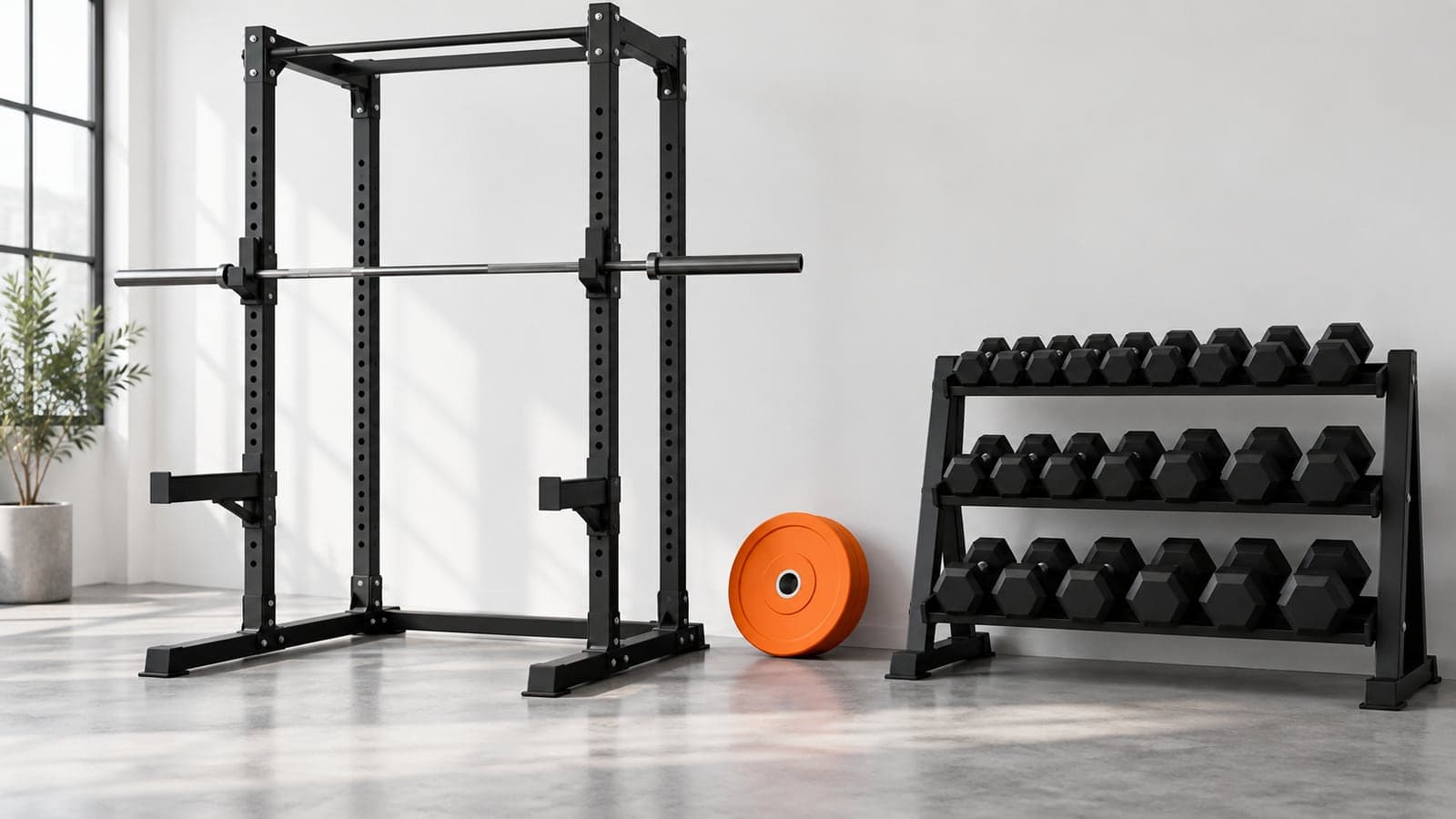
Full body vs split for hypertrophy: with the same number of weekly sets per muscle, both build the same amount of muscle. The research is consistent on that. So choose by how many days you can train and how long each session can run. Three days or fewer, go full body. Four or more, run a split.
What the studies say about full body vs split
Four papers cover this properly, and they agree more than people think.
Schoenfeld, Ratamess, Peterson, Contreras and Tiryaki-Sonmez (2015) put 20 well-trained men on either a split (each muscle once a week, 2 to 3 muscle groups per session) or a total-body routine (every muscle three times a week), same weekly volume, for 8 weeks. Forearm flexor thickness grew significantly more in the total-body group. Strength was the same. That paper started the "higher frequency wins" argument, and it's a fair reading of the data, but note what it compared: once a week against three times.
Bartolomei, Nigro, Malagoli Lanzoni, Masina, Di Michele and Hoffman (2021) ran 21 trained men for 10 weeks on total body or split. Both groups improved every strength and thickness measure. Vastus lateralis thickness went up more in the split group, and one bench press velocity measure went up more in the total body group. The authors leaned toward split for growth in experienced lifters and total body for strength, but the differences were small and mixed.
Evangelista and colleagues (2021), with Schoenfeld as a co-author, put 67 untrained people on an A/B split (each muscle twice a week) or full body (each muscle four times a week), with weekly sets equated, 8 to 12 reps, 60 seconds rest. After 8 weeks, bench, squat and muscle thickness of the arms and quads all went up, and nothing differed between groups.
Ramos-Campo, Benito-Peinado, Andreu-Caravaca, Rojo-Tirado and Rubio-Arias (2024) pooled 14 studies and 392 subjects. Bench press strength: no difference. Lower body strength: no difference. Elbow extensor, elbow flexor and vastus lateralis size: no difference. Lean mass: no difference. Their words were "solid evidence" that split vs full body doesn't matter for strength or hypertrophy when volume is equated.
The 2015 result makes sense once you add Schoenfeld, Grgic and Krieger's 2019 frequency meta-analysis: once a week is worse than twice, and beyond twice, frequency stops mattering when volume is equal. A split that trains each muscle once a week loses. A split that trains each muscle twice ties with full body.
So the question was never full body vs split. It's whether every muscle gets 10 to 20 hard sets a week in at least two sessions. Both can do that.
Full body vs split: how they compare
| Full body (3 days) | Split (4 to 6 days) | |
|---|---|---|
| Frequency per muscle | 3x | 2x (upper/lower or PPL) |
| Sets per muscle per session | 3 to 5 | 6 to 10 |
| Session length | 60 to 80 min | 50 to 75 min |
| Days needed | 3 | 4 to 6 |
| Exercises per session | 6 to 8, mostly compounds | 5 to 7, more isolation |
| Recovery demand per session | High (a squat or hinge every day) | Moderate (halves alternate) |
| Best for | 3 training days, beginners, strength focus, busy weeks | 4+ days, intermediates, lifters who want more per-muscle work |
| Weak point | Hard to fit enough arm, side delt and calf work | Missing one day drops a whole body region for the week |
A 3-day full body program
Monday, Wednesday, Friday. Each muscle three times a week, 4 to 5 sets each session, 12 to 15 weekly sets.
| Slot | Day A | Day B | Day C |
|---|---|---|---|
| Squat pattern | Back squat 4 x 5-8 | Leg press 3 x 10-12 | Front squat 3 x 6-8 |
| Hinge | Romanian deadlift 3 x 6-8 | Deadlift 3 x 4-6 | Leg curl 3 x 10-12 |
| Horizontal push | Bench press 4 x 5-8 | Incline dumbbell press 3 x 8-12 | Dips 3 x 8-12 |
| Horizontal pull | Barbell row 4 x 6-8 | Chest-supported row 3 x 10-12 | Cable row 3 x 10-12 |
| Vertical push or pull | Overhead press 3 x 6-8 | Lat pulldown 3 x 8-12 | Pull-up 3 x 6-10 |
| Isolation 1 | Lateral raise 3 x 12-15 | Curl 3 x 10-12 | Lateral raise 3 x 12-15 |
| Isolation 2 | Pushdown 3 x 10-12 | Calf raise 4 x 10-15 | Curl 3 x 10-12 |
Rest 2 to 3 minutes on the first three lifts, 90 seconds after. Progress with double progression: hold the weight until every set hits the top of the range, then add 2.5 kg upper or 5 kg lower. The method is spelled out in how to progressive overload.
Total is 7 exercises and about 23 sets a session, which is a 70-minute workout with honest rests. If that's too long, drop Isolation 2 on each day.
A 4-day upper/lower split
Monday upper, Tuesday lower, Thursday upper, Friday lower. Each muscle twice a week, 12 to 16 weekly sets.
| Day | Exercises |
|---|---|
| Upper A | Bench 4 x 5-8, barbell row 4 x 6-8, overhead press 3 x 6-8, pulldown 3 x 8-10, curl 3 x 8-12, triceps extension 3 x 8-12 |
| Lower A | Squat 4 x 5-8, Romanian deadlift 3 x 6-8, leg press 3 x 8-10, leg curl 3 x 10-12, calf raise 4 x 8-12 |
| Upper B | Incline dumbbell press 3 x 8-12, chest-supported row 4 x 8-12, lateral raise 4 x 12-15, cable row 3 x 10-12, cable fly 3 x 12-15, hammer curl 3 x 10-12, pushdown 3 x 10-15 |
| Lower B | Deadlift 3 x 4-6, split squat 3 x 8-10, leg extension 3 x 12-15, lying leg curl 3 x 12-15, seated calf raise 4 x 12-15 |
The complete version with rest times, warm-ups and the block structure is in the best workout split for 4 days a week. If you have five or six days, push pull legs vs upper lower covers how to spread the same sets over more sessions.
Who should pick full body
Three days or fewer. This is the main reason. With three sessions, a split gives each muscle one session a week, and once a week loses to twice in the frequency data. Full body gives three.
Beginners. Practising squat, hinge, press and row three times a week builds technique three times faster than once a week. Loads are light enough that daily compounds don't wreck you.
Strength as the priority. Bartolomei's total-body group had the edge on a strength measure, and squatting or benching three times a week is how strength programs are built anyway.
Unpredictable weeks. Miss a full body day and every muscle still got two sessions. Miss a split day and your legs got one.
Older lifters and anyone managing joints. Lower per-session load on any single muscle, and no day where one joint gets 15 sets. Sessions can be shorter with the same weekly total.
Who should pick a split
Four or more days. Sessions get shorter and you can put more into each muscle when it's there.
Intermediates and beyond. Once your squat is well over bodyweight, squatting three times a week with a hinge each time becomes a recovery problem. Bartolomei's split group grew more quad, and a split gives quads a whole day.
Lifters who want isolation work. Side delts, rear delts, biceps, triceps, calves. Full body has no room for them without 90-minute sessions. A split does.
Lifters who recover slowly. Each region gets 72 hours off. With full body, the same muscles are hit again in 48.
Anyone getting lean while keeping muscle. In a calorie deficit, recovery drops. Fewer big compound sessions and more machine and isolation work is easier to sustain, and a split makes that easier to lay out. Use the calorie calculator to set the deficit properly before you change the training.
How to switch without losing progress
The muscle doesn't know which split it's on. It knows the weekly sets and the loads. So when you switch:
- Keep the weekly set count the same. If you were doing 14 sets of chest a week on full body, do 14 on the split. Don't let the new format quietly add or drop volume.
- Keep the main lifts. Squat, bench, row, deadlift and press move across with their current weights and rep targets. That's your continuity. Your best sets carry over unchanged.
- Expect the first week to feel odd. Full body to split: the first upper day feels like too much chest and you'll be sore. Split to full body: leg work three times in one week feels relentless. That settles in two weeks.
- Don't reset the weights. A common error is dropping 10% to adapt. You lose two weeks for nothing. Keep the loads, and add 1 rep in reserve to your targets for the first week if you need to.
- Switch at a deload. The clean way: run your deload week, then start the new split fresh. Deload week how often covers the timing.
Mistakes
- Running a bro split and calling it a split. Chest Monday, back Tuesday, legs Wednesday, shoulders Thursday, arms Friday is a once-a-week frequency. That's the one arrangement the data argues against.
- Full body with 12 exercises. Four sets each and you're there two hours. Seven exercises, pick the big ones.
- Changing split every month. Every switch costs you two weeks of comparisons. Pick one, run it for three months minimum.
- Judging by soreness. A split makes you sorer because each muscle gets 10 sets at once. That isn't more growth. Ramos-Campo's meta-analysis says it's the same growth.
- Ignoring the arms and side delts on full body. They don't get enough from compounds alone. Two isolation slots a session, minimum.
How to run either in Ultra+
Ultra+ builds your starter plan from the quiz before you open the app. Say three days and you get a full body week. Say four or five and you get a split. It's built around the days and the equipment you told us about, so there's no blank template to fill in on day one.
Every set shows your previous set and your all-time best set for that exercise, and those follow the exercise, not the program. Switch from full body to upper/lower and your bench history is still on the screen when you bench. After each session the summary shows total volume and the change from the last time you ran that same template, so a switch never hides a drop in work.
When you want to change format, ask Blaze. He reads your recent sessions and proposes the new week for you to approve. He never changes the plan on his own.
Start your free trial and your first week is built from the days you have.
Frequently asked questions
- Is full body or a split better for building muscle?
- Neither, when weekly sets per muscle are equal. A 2024 meta-analysis of 14 studies found no difference in strength or muscle size between split and full-body routines. Pick full body if you train three days or fewer, and a split with each muscle trained twice a week if you train four or more.
- Can you build muscle with full body workouts 3 times a week?
- Yes. Three full-body sessions give every muscle 12 to 15 hard sets a week across three exposures, which is inside the range linked to the best growth. Untrained people in an 8-week 2021 trial grew the same on full body as on a split with equal sets, and trained men in a 2015 trial grew slightly more.
- Is a bro split bad for hypertrophy?
- It's the weakest common option. Training each muscle once a week lost to twice a week in the 2016 frequency meta-analysis, and Schoenfeld's 2015 trial found less arm growth on a once-a-week split than on a three-day full body. If you like body-part days, run push/pull/legs twice a week instead.
- How many days a week should I do full body?
- Three. Monday, Wednesday, Friday gives each muscle 48 hours before it's trained again and a weekend off. Two days works for maintenance or very busy periods. Four full-body days is workable for beginners with light loads, but most lifters past that point should switch to an upper/lower split.
- Should I switch from full body to a split?
- Switch when you can train four or more days, your squat and deadlift are heavy enough that doing them three times a week hurts recovery, or you want more isolation work than full body allows. Keep your weekly sets and current weights the same across the switch and time it after a deload.
References
Every study below was opened and read before it was cited.
- Influence of Resistance Training Frequency on Muscular Adaptations in Well-Trained MenSchoenfeld BJ, J Strength Cond Res, 2015
- A Comparison Between Total Body and Split Routine Resistance Training Programs in Trained MenBartolomei S, J Strength Cond Res, 2021
- Split or full-body workout routine: which is best to increase muscle strength and hypertrophy?Evangelista AL, Einstein (Sao Paulo), 2021
- Efficacy of Split Versus Full-Body Resistance Training on Strength and Muscle Growth: A Systematic Review With Meta-AnalysisRamos-Campo DJ, J Strength Cond Res, 2024
- Effects of Resistance Training Frequency on Measures of Muscle Hypertrophy: A Systematic Review and Meta-AnalysisSchoenfeld BJ, Sports Med, 2016
- How many times per week should a muscle be trained to maximize muscle hypertrophy? A systematic review and meta-analysis of studies examining the effects of resistance training frequencySchoenfeld BJ, J Sports Sci, 2019
Related
Written by Sebastian, founder, ultra+. Sebastian founded Ultra+ and lifts. He writes every article on this site and checks each cited study himself.